

FROM SHAMBAS TO SCREENS; INSIDE NANDI’S GIS–KIAMIS SMART FARMING LEAP
In the green highlands of Nandi, a quiet data revolution is taking shape one that could make every hectare, herd and horticulture plot count more in the county’s balance sheet. By integrating GIS land mapping with the national KIAMIS platform, Nandi aims to turn scattered registers into a smart engine for revenue generation across crops, livestock, and horticulture value chains.
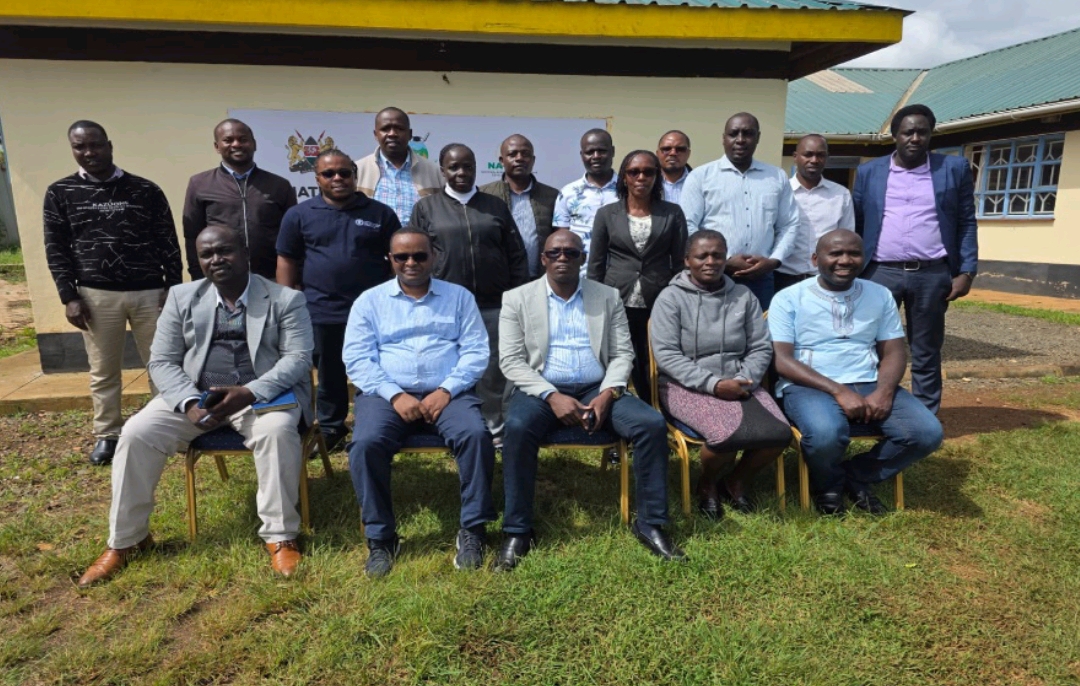
A recent technical consultative meeting between the Nandi County Agriculture Department and FAO technical team placed one idea at the centre of reform: data must become a working asset, not a forgotten archive. Officials and experts reviewed how agricultural information is captured, stored, secured and used, and agreed that systems must be integrated and georeferenced if they are to drive real decisions on the ground.
Dr. Kiplimo Lagat emphasized that GIS-linked KIAMIS should go beyond farmer registration to become a living agricultural intelligence platform for Nandi County. He noted that the system must provide dynamic, regularly updated data to support daily policy, planning and field-level decisions across farms, value chains, markets, extension services, disease surveillance and climate risks. He further stressed that KIAMIS must be interoperable with county GIS, livestock, cooperative, market, weather and extension systems, while remaining simple enough for ordinary farmers and last-mile extension officers to use in making practical decisions on production, inputs, aggregation, market access and productivity improvement..
Mr. Micheal Kigathi from FAO states that integrating GIS capability into departmental data systems for planning, targeting and analysis, starting with pilot linkages for mapped programmes by September. This means that land parcels, farms, grazing blocks and irrigation schemes can be visualized alongside production and value-chain indicators on interactive dashboards.
Dr. Paul Sanga, informed members that once KIAMIS data is georeferenced, county planners will be able to quickly identify underserved areas in extension services, disease hotspots, and zones where specific crops or enterprises are concentrated. That spatial view will allow the county to target investment in roads, market sheds, aggregation centres, and water points where they can unlock the greatest economic return per shilling invested.
The meeting further recognized that existing crop datasets remain incomplete and often lie idle after initial registration. To address this, a rapid mapping of data gaps across agriculture, livestock, and related value chains has been agreed upon, with the goal of defining a minimum departmental dataset and updating collection tools. For crops, this means capturing not just farmer names, but also farm sizes, locations, cropping patterns, and yields in formats that feed directly into KIAMIS dashboards
Dr. Muchelule Yusuf from FAO reminded members that with stronger, mapped data, the department can identify high-potential crop zones and tailor input support, mechanisation services and storage investments accordingly. Weekly digital submission of field data, combined with prototype dashboards targeted for completion by August, will allow managers to track which crop programmes are driving revenue growth and which require strategic adjustment. Over time, this precision planning could help farmers shift toward more profitable crops and gain access to better markets.
County Director of Veterinary Services Dr. Daniel Chepkwony stated that Livestock data is central to Nandi’s smart farming ambitions, particularly in animal health surveillance and value-chain development. The meeting singled out training needs on tools such as the Kenya Animal Bio-Surveillance System (KABS), as well as data management and analytical skills for veterinary and livestock staff
Mr. Victor Micheni stated that integrating livestock records into a GIS-linked KIAMIS environment will allow the county to map disease hotspots, track vaccination coverage, and align surveillance routes with real animal movement patterns. This would strengthen outbreak prevention, reduce livestock losses, and protect pastoral and mixed-farming incomes. At the same time, better data on herd sizes and locations improves the county’s ability to attract investment in milk collection, meat processing, and feed supply chains.
Beyond cereals and dairy, the meeting highlighted several emerging value chains that could benefit from smarter data and mapping systems, including apiculture, organic manure, aquaculture, mushroom production, and other enterprises. These sectors were identified as quick wins for income diversification if properly documented and integrated into county data systems
CO for Agriculture and Cooperative development informed members that Action points call for better capture of apiculture and organic manure within value-chain systems, and for their inclusion in extension content, dashboards and programme tracking. When such enterprises are geocoded, showing where bee-keepers, mushroom growers or fish farmers are located, Nandi can design targeted support packages, cluster producers for marketing, and build niche brands that bring premium prices to local farmers.
Dr. Muchelule from FAO underscored the need for a secure, county-owned departmental data management framework with clear user roles, access and editing controls aligned to Nandi’s Data Protection Impact Assessment (DPIA) and internal approval processes.
Mr. Bowen County Monitoring and Evaluation Officer assured members that the department will apply DPIA screening to new digital systems, dashboards and partner platforms to ensure safe, compliant handling of agricultural data. Weekly digital reporting, regular management coordination meetings and an implementation tracker are expected to keep reforms on course and ensure that maps and dashboards actually influence policy and budgets.
Technical ambition must be matched by human capacity, and Nandi has acknowledged this head-on. Targeted capacity building is planned for veterinary, agriculture, ICT and analytical staff, covering topics from surveillance tools and data quality to dashboard use and digital reporting.
The Chair, Dr. Paul also encouraged members that Benchmarking visits to data-advanced counties such as Kiambu, Kirinyaga and Homa Bay are also on the agenda, allowing Nandi teams to learn directly from peers who have already piloted value-chain dashboards and integrated systems. If the county can turn these lessons into a functioning, GIS-enabled KIAMIS ecosystem, Nandi’s famed green hills may soon be known not just for tea and milk, but for how smart data quietly powers the prosperity behind them.
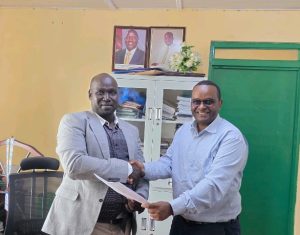 Mr. Micheal Kigathi from FAO hands over Nandi-FAO team discussion report to CO Agriculture Dr. Paul Sanga